Shark Influencers Are Calming Fears Post-'Jaws'. But Do They Take It Too Far?
Where sunlight tells stories.
Ocean Ramsey, a marine biologist and conservationist, is the subject of a new Netflix doc "Shark Whisperer."(Photo: Courtesy of Netflix)
Fifty years ago,Jawshit theaters with the force of a tsunami, and proceeded to scare the living daylights out of millions of viewers. Beach attendanceplummetedin the months following the film’s release, and more than a third of viewers reported feeling an increased sense of fear while swimming. The “Jaws Effect” was so powerful during those days that some people evenavoided swimming pools.
Decades later, surprisingly little has changed. In 2015, four decades afterJawspremiered,38 percent of Americans were still afraidto swim in the ocean because of sharks, and more than half admitted to experiencing galeophobia, a general fear of sharks.
I see this fear firsthand as a scuba diver. The first question people inevitably ask me is:What would you do if you saw a shark?
I don’t have to wonder. I’ve encountered hundreds. And they’re beautiful. I watched dozens of hammerheads swirl around me in the Red Sea,and I’vedrifted through French Polynesia’s legendary “Wall of Sharks,” where up to900 reef sharksgather in a single day. One of the most incredible moments of my life came at a remote dive site off Mexico’s Baja Peninsula, where I floated peacefully above a river of 100 silky sharks.
I consider myself lucky that I didn’t seeJawsuntil my mid-twenties, after many real-life shark encounters. TheNew York Timescalls Spielberg’s film a“masterpiece that changed cinema”—but it’s fiction. Sharks don’t crave human flesh. Most attacks on humans are likely cases of mistaken identity; from below,surfers look like seals, which are on sharks’ menu. There were only 47 unprovoked shark bites worldwide last year, according to theInternational Shark Attack File. Just four of them were fatal. To put that in perspective, around100 people die each year from jellyfish stings.
And humans pose a much bigger threat to sharks than they pose to us. We kill roughly100 million sharks annually—a major problem for us when they are key to maintaining the stability of ocean food chains that feed billions of people around the world.
After decades of fear, a new generation of social media activists hopes to reverse the narrative. They’re flooding our feeds with peaceful, viral encounters aimed to replace terror with awe and understanding.
But can influencer-driven messaging truly repair decades of damage? Or does it present new, unintended risks for sharks?
HowJawsScarred (and Inspired) Generations
Jawsdidn’t invent a fear of sharks. By the sixties, occasional scares prompted short-lived panics. After one shark scare near Coney Island, theNew York World-Telegramreportedthat city police “triggered several bursts of machine gun fire, aiming into the water for the benefit of photographers.” Such theatrical responses were typically enough to reassure beachgoers—or a time.
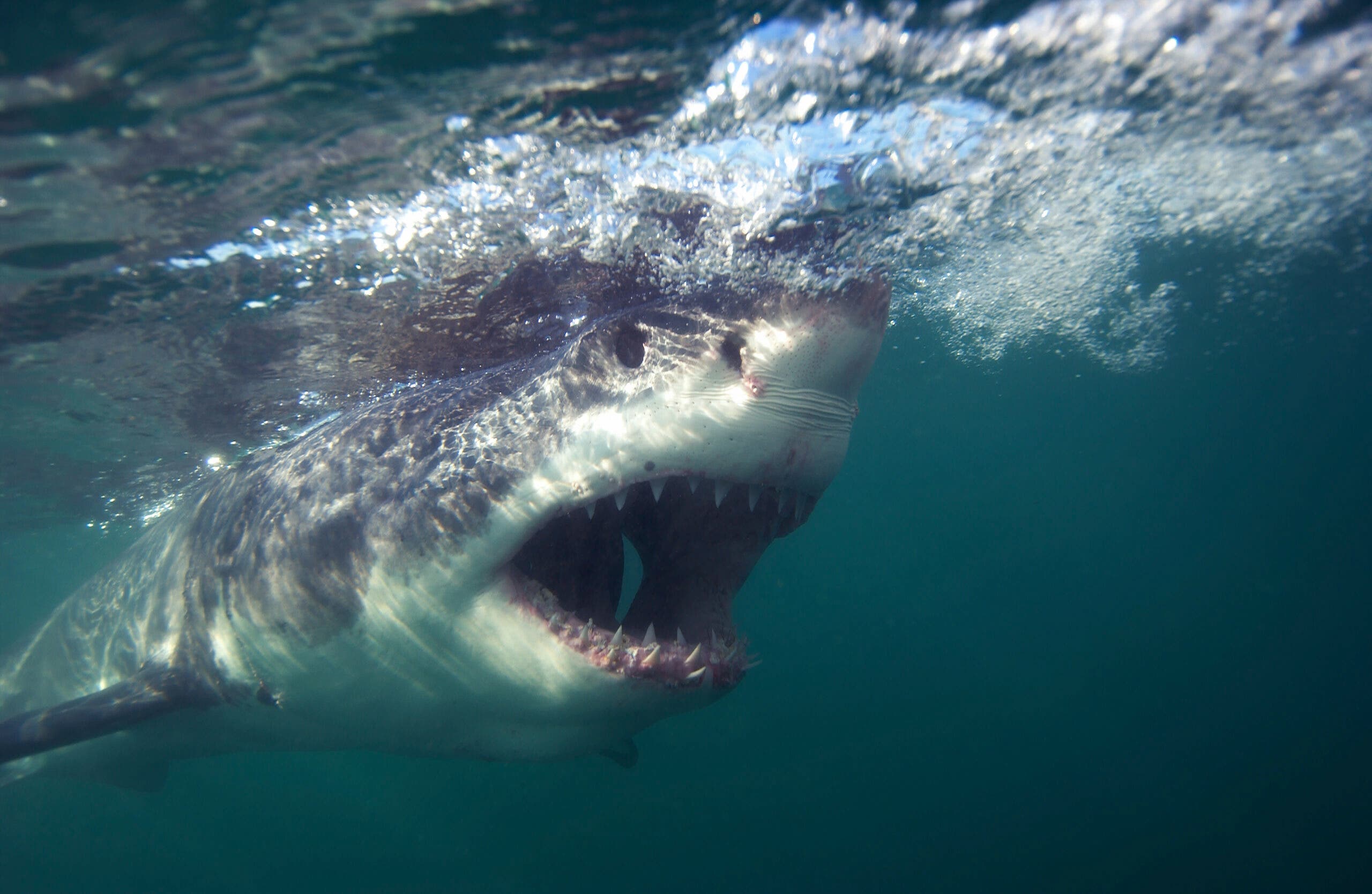
But whenJawshit screens in 1975, it etched these fears into our collective consciousness. Virtually overnight, thegreat white shark—and by extension all sharks—were perceived as ruthless killers prowling the coasts.
“One of the great things, in movie terms, about a shark as the villain is that you can’t anthropomorphize it,” Linda DeLibero, a film lecturer at Johns Hopkins University, said in aJaws 50th anniversary webinar. “It doesn’t seem to have any personality or feelings.”
A great irony ofJawsis how difficult it was for even the filmmakers to evensimulatea shark attack.
“They had the rather ridiculous notion that for the shark shots, they could just get a real shark and a trainer and have the shark learn some tricks,” said DeLibero. “They quickly realized that that was absolutely ridiculous, and so they built these mechanical sharks” that rarely worked. “If you’re paying attention, the shark is invisible until that amazing moment—probably the biggest shock in the film—when Brody is throwing the chum overboard and it pops up out of the water. The shark worked that day, and they weren’t happy with the way it looked, but it didn’t really matter.”
This engineered portrayal had real-world consequences. Shark-fishing tournaments surged in the late seventies, withthousands of sport fisherseager to reenact the heroics ofJaws’shark hunter, Captain Quint.
While public fear itself didn’t cause the global decline of shark populations, it severely undermined early conservation efforts. Sympathy for sharks was effectively crushed by their portrayal as relentless monsters.Scientists saythis has made it difficult over the years to get public or political support to regulate shark fishing or reduce accidental catches (bycatch).
“Whenever I say 37 percent of all named species of sharks and their relatives are threatened with extinction, there’s always someone who says, ‘Good. How can we get that to 100%?’” says Dr. David Shiffman, a marine conservation scientist at Johns Hopkins and author ofWhy Sharks Matter.
“The fact that so many people are absolutely terrified of sharks—which many of them trace back toJaws—makes it harder for us to care and lobby or and to elicit public support to lobby for conservation. That is a big problem, not only for sharks, but for the oceans as a whole and for humans. Sharks play vital roles in keeping coastal and oceanic ecosystems healthy.”
Even now, public officials invoke the film to justify anti-shark measures. Fictional Amity Island mayor Larry Vaughn, who notoriously kept beaches open despite shark attacks, remains a shorthand for political mismanagement of shark incidents. Nobody wants to follow in his footsteps. In 2023 George Gorman, the Long Island regional director for New York State Parks, explained drone patrols and beach closures after five shark bites in two days by saying “I don’t want to be the mayor of Amity.” And between 2000 and 2014, officials in Western Australia repeatedly ordered controversial shark culls by claiming there was an “imminent threat,”echoing the film’s narrativeof rogue killer sharks.
Jawsalso shaped legions of imitators. A2019 study of 109 shark-related filmsfound that 96 percent portrayed sharks as threatening to humans.Finding Dorywas the only exception. Some of such media is just absurd fun, likeSharknadoandMega Shark Versus Giant Octopus. But even those films resonate precisely because sharks are ready-made villains. It’s like putting Nazis in your film: it’s an instant shorthand for evil.
Then there’s the Discovery Channel’s annual Shark Week, which Shiffman calls “a dumpster fire of lies, pseudoscience, and nonsense.” After analyzing 206 hours of Shark Week programming, his team concluded it primarily reinforces existing misconceptions of sharks as mindless threats, and rarely discusses threats to sharks or how they can be addressed.
A dive operator in the Bahamas once told me, allegedly, that a Shark Week production crew that chartered his vessel filled a faux pig with fish guts to emulate sharks attacking pigs from Big Major Cay, where tourists swim with the famous wild pigs.
Yet for all its harmful impacts,Jawsparadoxically inspired a legion of ocean conservationists. “There’s a generation of marine scientists who became scientists because they sawJawsand wanted to be Hooper,” says Shiffman referencing the oceanographer that is brought to Amity to help deal with the shark. Indeed, The American Elasmobranch Society (AES) was founded in 1982, just seven years afterJawspremiered.
Sharks Enter Their Influencer Era
Jawsis enduring proof that media has a strong influence on how the public views sharks. Today, shark influencers likeOcean RamseyandAndriana Fragolaare hoping to use the power of social media for conservation, not demonization.
All over Instagram and TikTok, influencers swim beside tiger sharks, calmly redirect an approaching reef shark, and reach millions of followers. Their graceful footage, often accompanied by educational conservation captions, frequently gets shared across the Internet. These peaceful shark encounters directly contradict the idea that sharks will eat anything on site. This may help unwind our cultural shark frenzy.
“People look first and listen second,” says Ramsey, a freediving shark conservationist with a combined audience of over 4 million onTikTokandInstagramwho stars in the upcoming Netflix documentaryShark Whisperer. “Photos and videos transcend language barriers…They directly challenge theJawsarchetype, and are reality.Jawswas a fictitious film.”
It’s also an opportunity to highlight the ways sharks are threatened by humans.
“I also will share videos where you can see the human impacts on sharks,” says Fragola, a marine biologist andshark tour guidewith aTikTokaudience of 2.2 million. “If they have a broken jaw, or there’s a fishing line hanging from them, or they’re entangled in something, that’s all caused by humans…People write comments like ‘Wow, I feel really bad for this animal having these human impacts.’ And I think having that direct connection is something that’s really important for conservation.”
Of course, influencer content can cross a line: “A video of someone riding a shark, of someone hugging a shark, of people flipping sharks over—there was one guy who used to kiss sharks,” says Shiffman. “That does not prove that sharks are cute, cuddly animals. It shows that if you annoy a wild animal, it’s gonna bite you. And I’m not sure how much that helps anyone or anything.”
Not everyone agrees where that line is. In 2019, Ramsey went viral for swimming with and touching the fin of a 20-foot pregnant great white. The footage immediately sparkedbacklashfrom marine scientists, who accused her of interfering with the shark’s critical feeding opportunity.
“I’m not trying to inspire people to interact” with sharks, insists Ramsey. “I’m trying to inspire people to get involved in shark and ray conservation.” She encourages people to, for example, pressure FedEx to stop shipping shark fins, purchase beauty products that use the vegan squalane instead of shark-based squalene, eat sustainable seafood to reduce shark bycatch, and advocate for states like New York, South Carolina, Alabama, Florida and Texas to end shark fishing competitions. Ramsey also was heavily involved advocating for Hawaii’s 2022 shark fishing ban and an EU shark fin ban currently under parliamentary review.
If somebody does want to encounter a shark in their natural habitat, they should go with a specialist, not only to be safer, but to maximize the amount of learning, she advises.
While influencers may be giving sharks some much-needed good PR, not all of them are trying to erase the risks of interacting with an apex predator.
“Sharks are not mindless eating machines—but they’re also not puppies,” cautions Fragola, whosepinned Instagram postsshow sharks as both risk (coming so close she must redirect them) and victim (a shark with severe jaw damage, likely harmed by fishing). “If people only see sharks being peaceful, they think that’s how they always are. If they only see aggression, they think it’s always dangerous. Neither is true.”
Come 2075, our perception of sharks will reflect how well today’s storytellers wield their influence.
Alexandra Gillespiedove with reef sharks in Belize on her first assignment as digital editor of Scuba Diving magazine, and she’s jumped at the chance to do so ever since. With about 170 dives under her belt, she is a freelance journalist covering water and travel. Her writing has appeared inNational Geographic, NPR,Afar, andU.S. News and World, among other national publications.